
Most parents notice it at some point: their child stares at a Maths worksheet, counts on fingers, and still gets the answer wrong. It is not a lack of effort. More often than not, the child simply has not been shown a method that clicks for them. Abacus training is one of the oldest and most proven approaches to building number sense and speed arithmetic, but it only works well when it is taught correctly. That is exactly why one on one online tuition for children has become such a popular route for parents who want to give their child a genuine head start in Maths, from primary school right through to GCSE preparation.
According to a 2023 study published by the National Centre for Excellence in the Teaching of Mathematics (NCETM), children who develop strong mental calculation habits in their early years consistently outperform their peers in KS2 SATs and beyond. The abacus is one of the most effective tools ever developed for building those habits, and when it is paired with the focused attention of a skilled tutor, the results can be remarkable.
This blog explores how one on one online tuition for children accelerates abacus learning, why personal attention makes such a measurable difference, and what to look for when choosing the right tutor for your child.
Why Abacus Training Matters for Young Learners
The abacus has been used for over 2,000 years across Asia, the Middle East, and Europe as a calculation tool. Today, abacus training is widely recognised by educators not just as a maths aid but as a full brain development programme. Research from the University of Chicago found that children who receive structured abacus training demonstrate stronger spatial reasoning, working memory, and number fluency compared to those who learn standard arithmetic alone.
For children in primary school working toward their Year 6 SATs, building mental math skills for kids early creates a compounding advantage. A child who can mentally calculate 347 plus 568 in under five seconds does not just perform better in timed tests. They also approach GCSE Maths topics with greater confidence because the numerical foundations are already solid.
Developing strong mental math skills for kids through abacus training also reduces maths anxiety, which affects roughly 17% of children in the UK according to a 2022 report from the University of Cambridge. When numbers feel manageable and fast, children stop dreading Maths and start engaging with it.
How the Abacus Builds Speed and Accuracy
The abacus works by representing numbers physically through bead positions. Children manipulate beads to perform addition, subtraction, multiplication, and division. Over time, with consistent practice, the physical abacus transitions into a mental image. Children begin to visualise bead movements in their heads, which allows them to calculate rapidly without writing anything down.
This mental image technique, sometimes called mental abacus or anzan, is what makes abacus-trained children so fast at mental arithmetic. A child who has practised for 6 to 8 months consistently can often calculate 10-digit additions in under 3 seconds. But reaching that stage requires a structured progression, correct technique from the very beginning, and regular feedback to fix errors before they become habits.
Why One-on-One Online Tuition Speeds Up Abacus Learning
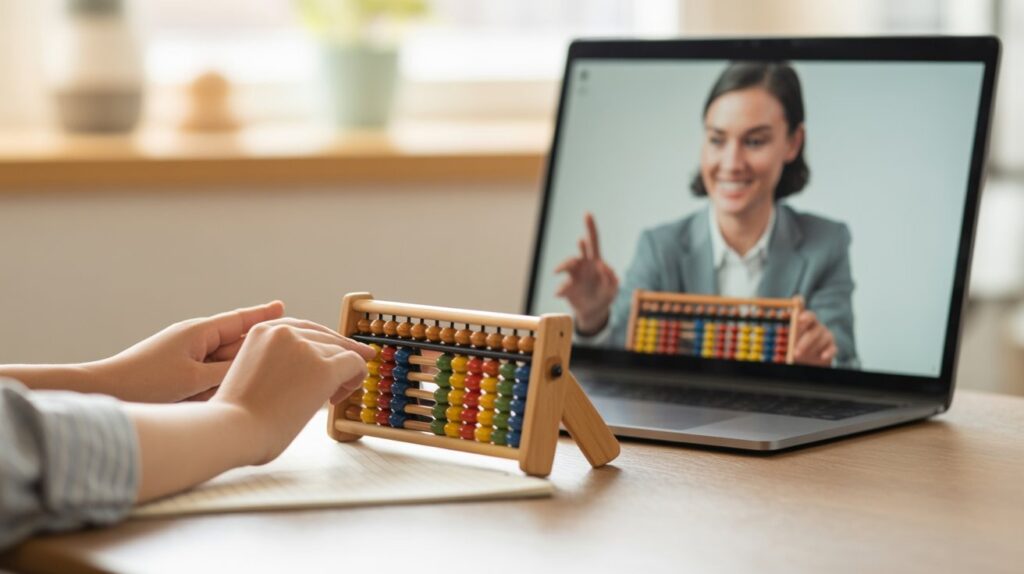
Group abacus classes exist, and they have their place for general exposure. But when it comes to genuine speed and accuracy development, nothing matches one on one online tuition for children in terms of pace and personalisation. A tutor working with a single child can spot a misaligned technique in real time and correct it before it becomes a problem. In a group class of 10 or 12 students, that level of individual attention is simply not possible.
The other major advantage of one-to-one sessions is that the lesson moves at the child’s speed. Some children move through the foundational levels of abacus in 4 weeks. Others need 8 weeks to feel confident before advancing. In a group setting, both children are often moving at the same pace regardless, which means one is bored and the other is overwhelmed. Individual sessions remove that tension entirely.
Online Abacus Tuition Versus In-Person Classes
Online abacus learning for children has grown significantly since 2020. What began as a necessity during school closures has become a preferred option for many families because of the practical advantages. There is no travel time, no fixed centre schedule, and no geographic limit on which tutor you choose.
With online abacus learning for children, a child in Birmingham can work with a specialist tutor in Edinburgh, and the session can take place on a Tuesday evening after school rather than requiring a Saturday morning trip to a class. Shared digital whiteboards and screen-mirroring tools make it fully possible for a tutor to observe bead movements and technique in real time, giving feedback just as effectively as if they were sitting next to the child.
According to research from the Education Endowment Foundation (EEF, 2024), one-to-one online tutoring adds an average of five additional months of academic progress compared to standard class-based teaching. For a subject like abacus that depends heavily on precise technique and consistent progression, that additional progress is not just a statistic; it is visible in how quickly children advance through levels.
How Children in Birmingham and Chicago Are Progressing Faster With Private Abacus Tuition
Families in cities like Birmingham and Chicago have been among the earliest adopters of private online abacus tutoring, and the results being reported by parents speak clearly. In Birmingham, where competitive grammar school entrance exams like the 11-plus test heavily emphasise numerical reasoning and mental arithmetic, many parents are turning to abacus classes for kids as a preparation tool that works far beyond a single exam.
Oliver Patel, a Year 4 student at St. George’s C of E Primary School in Birmingham, began abacus classes for kids through online one-to-one sessions in January 2025. His tutor used a structured 12-level abacus programme combined with weekly timed mental arithmetic tests. By April 2025, Oliver had moved from Level 1 to Level 4 and improved his mental addition speed from 18 seconds to under 6 seconds for 5-digit sums. His class teacher noted the improvement independently in his spring term report.
In Chicago, private abacus tutoring has grown alongside STEM enrichment programmes. Students preparing for gifted and talented school entrance assessments frequently include abacus training in their preparation because of the speed and accuracy advantage it provides in timed problem-solving sections.
What Personalized Abacus Tutoring Actually Looks Like
Personalized abacus tutoring is not simply sitting a child in front of an abacus and asking them to count beads. A skilled tutor begins with a diagnostic session to assess the child’s existing number sense, any prior exposure to abacus, and their general learning style. From that session, a structured programme is built that matches the child’s starting point exactly.
For most children starting from scratch, personalized abacus tutoring begins with single-digit manipulation on a physical or virtual abacus, building gradually toward multi-digit addition and subtraction before introducing multiplication and division. The transition from physical to mental abacus is introduced carefully, usually once the child is consistently accurate at Level 3 or 4, to ensure the mental image is reliable before it is relied upon.
Each session also builds in timed practice. Speed without accuracy is useless in a Maths exam, but accuracy without speed is equally problematic in a timed SATs paper or GCSE Higher tier question. A good tutor balances both throughout every session, tracking progress across weeks and adjusting the pace and difficulty accordingly.
Finding the Right Private Abacus Tutor for Your Child
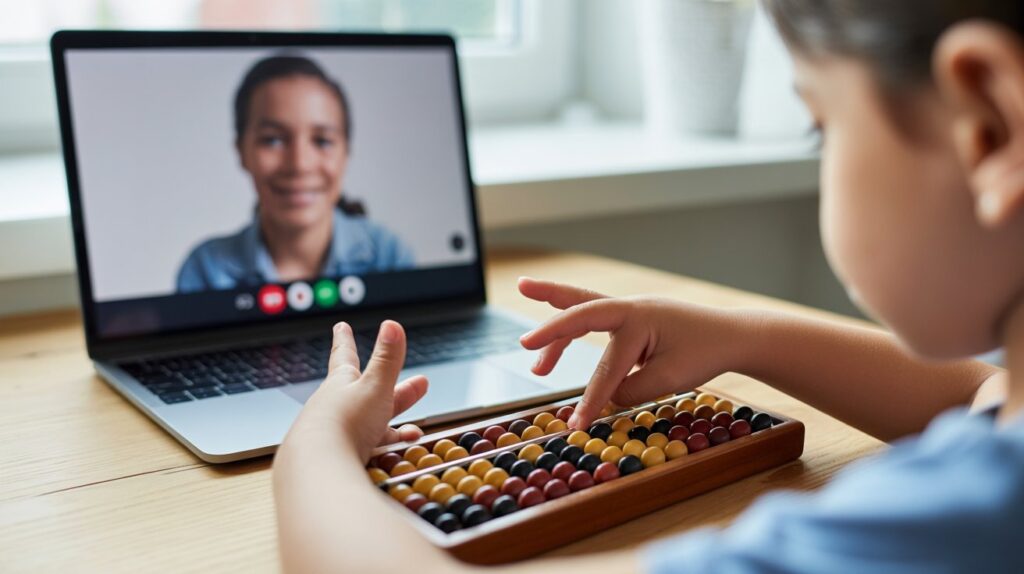
Not every Maths tutor is equipped to teach abacus, and not every abacus instructor understands how to align that training with the UK primary curriculum or GCSE requirements. A private abacus tutor who is genuinely effective for a child in the UK needs to understand both the abacus methodology and how it connects to the Maths skills that KS1, KS2, and KS3 assessments actually test.
When looking for a private abacus tutor, here are the qualities that matter most:
• Specific abacus training: Look for tutors with formal abacus instructor certification, not just general Maths teaching experience.
• UK curriculum knowledge: The tutor should understand how abacus skill development connects to SATs mental arithmetic, KS3 number work, and GCSE Maths foundations.
• Clear progression structure: A good tutor can explain exactly which level the child is at, what the next milestone looks like, and how long it should realistically take to reach.
• Regular parent updates: Parents should receive session notes after every lesson, including what was covered, accuracy rates on timed tests, and the focus for the week ahead.
• Free diagnostic assessment: A confident tutor will always offer a first session assessment before any payment commitment, so both parent and child can judge the fit.
You can also explore how structured Maths support connects with test preparation for competitive and school exams, where mental calculation speed plays an important role.
Signs Your Child Is Ready to Start Abacus Training
Many parents wonder whether their child is too young or too old to start abacus training. The honest answer is that children between 5 and 12 years old tend to benefit most because this period aligns with the key stages of numerical development. Children in this range are still building their foundational understanding of number, which means abacus training shapes those foundations directly rather than trying to correct habits that have already formed.
Watch for these signs that your child is ready to begin:
• They can count to 20 reliably but struggle to add and subtract without using fingers
• They lose confidence in Maths lessons when calculations become multi-step
• They are preparing for the 11-plus, Year 6 SATs, or any entrance exam with a numerical reasoning component
• They find written column methods slow and make frequent carrying errors
• They enjoy repetitive, structured activities and respond well to visible progress
How YourTutor365 Supports Abacus and Maths Development for Children
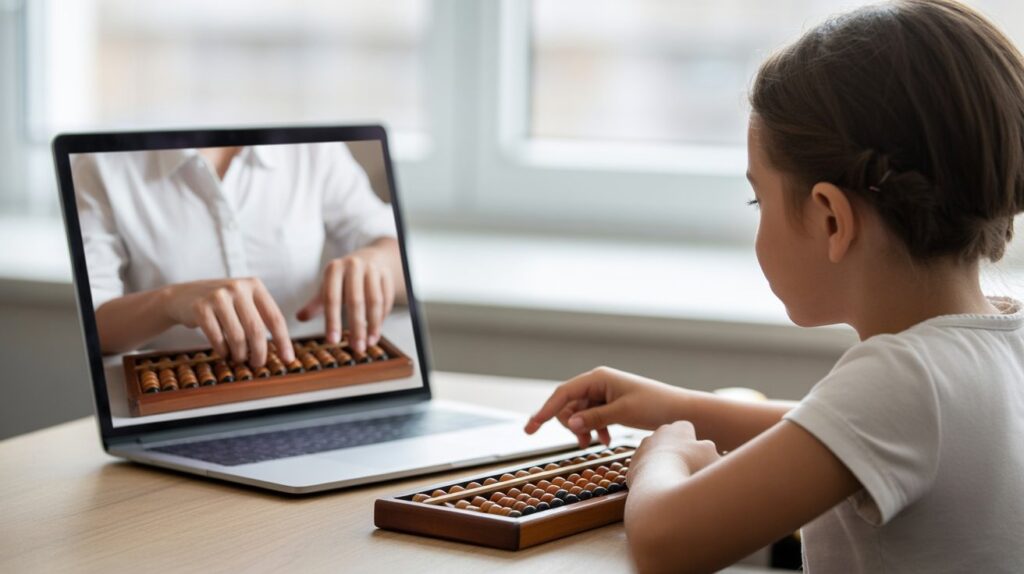
YourTutor365 offers fully personalized, live one-to-one Maths and logical reasoning sessions for children from Grade 1 through to GCSE level. Every child begins with a free diagnostic assessment that identifies their current number skills, their learning style, and the most effective starting point for their programme.
Tutors at YourTutor365 are matched to each child based on subject expertise, teaching approach, and the specific goals the family has set. For children working on abacus and mental arithmetic development, sessions are structured around a clear level-by-level progression, with timed practice, regular feedback, and written updates for parents after every session.
The platform supports students across the United Kingdom and internationally, with students in cities including Manchester, Leeds, Bristol, Toronto, and Dubai. Whether your child is in Year 3 developing their first mental Maths habits or in Year 9 looking to strengthen their numerical foundations ahead of GCSE, the right tutor is available. You can also read more about how individual attention accelerates learning in our blog on how personalized tutoring helps students achieve better results.
Conclusion
Abacus training is one of the most effective tools available for building the kind of numerical confidence that stays with a child all the way from primary school through to GCSE and beyond. The research is consistent, the outcomes are visible, and the method is proven. But it works best when it is taught well, at the right pace, with real-time feedback and a structure that matches where the child actually is. That is exactly what skilled one-to-one online tutoring provides.
Whether your child is 6 years old and just beginning to understand numbers, or 11 years old preparing for their 11-plus entrance exam, starting structured Maths support now creates advantages that compound over time. The children who develop strong mental arithmetic habits early are the ones who approach GCSE Maths without fear, and that confidence starts with the right foundation.
If you are ready to give your child a real advantage in Maths, YourTutor365 is here to help. Start with a free assessment, meet a specialist tutor, and see the difference that genuine personal attention makes.
Frequently Asked Questions (FAQs)
Q1. What age is best for a child to start abacus training?
Children between 5 and 12 years old tend to benefit most from abacus training because their numerical foundations are still forming. Starting during KS1 or early KS2 gives children the most time to develop mental arithmetic fluency before it becomes critical in SATs and secondary school Maths.
Q2. How quickly will my child see results from online abacus tuition?
Most children who attend two sessions per week show measurable improvement in mental arithmetic speed and accuracy within 6 to 8 weeks. Students who progress to Level 3 or 4 of a structured abacus programme typically see a significant increase in how confidently they approach Maths tasks both at home and in school.
Q3. Is online abacus tutoring as effective as in-person classes?
Yes, research from the Education Endowment Foundation consistently shows that one-to-one online tutoring produces comparable or better results than group in-person classes. Digital whiteboards and screen sharing allow tutors to observe technique and provide corrections in real time, making the experience genuinely equivalent to a face-to-face session.
Q4. Can abacus training help my child with GCSE Maths preparation?
Absolutely. While abacus training is most commonly associated with younger learners, the mental arithmetic speed and number sense it builds are directly useful in GCSE Maths, particularly in non-calculator papers where accuracy and speed under time pressure determine the final grade.
Q5. How do I know which abacus level my child should start at?
A good tutor will always begin with a diagnostic assessment that tests the child’s existing number knowledge, mental calculation speed, and current accuracy. From that session, the tutor identifies the appropriate starting level and builds a programme around it, rather than placing all new students at Level 1 regardless of what they already know.
