
Picture a Year 5 boy in Manchester named Oliver, diagnosed with ADHD at the age of 7. By the time he started Year 6 and SATs preparation began, sitting through a 30-minute online lesson was practically impossible. His mum tried three different tutors in six months. Then, in January 2024, she switched to a platform that used badge systems, timed maths challenges, and progress maps built into every session. Within eight weeks, Oliver was completing full 45-minute lessons without a single break request. Stories like this are exactly why so many families are now exploring online tutoring for ADHD students in the UK that uses gamification as a core teaching strategy rather than an afterthought.
ADHD, or Attention Deficit Hyperactivity Disorder, affects roughly 5% of school-age children in England, according to the NHS. That translates to approximately 1 in 20 pupils in any given primary or secondary school classroom. For these children, conventional lesson formats with long explanations and passive listening are simply not designed around the way their brains work best.
Gamification changes that equation. By introducing game-like elements such as points, levels, rewards, challenges, and instant feedback into learning sessions, tutors can tap into the dopamine-driven reward system that ADHD brains respond to most strongly. This article explains exactly how that works, which techniques matter most, and what parents and tutors should know when applying them.
Understanding Why ADHD Students Struggle in Traditional Online Lessons
Before exploring the solutions, it helps to understand the problem clearly. Children with ADHD typically have lower levels of dopamine and norepinephrine in the prefrontal cortex, the part of the brain responsible for attention, impulse control, and working memory. This is not a behaviour problem. It is a neurological one.
Online lessons, if delivered without any adaptation, often make this worse. A child staring at a static screen with a talking head and a shared document has fewer sensory inputs than a physical classroom. There is no movement, no texture, no immediate social feedback from peers. For a neurotypical child, this is manageable. For a child with ADHD, the cognitive demand of forcing attention onto a low-stimulation screen is exhausting within minutes.
According to a 2023 report from the British Dyslexia Association and ADHD Foundation UK, the most common barriers ADHD children face in online learning include:
• Difficulty sustaining attention for more than 10 to 15 minutes without an activity change
• Impulsive responses that disrupt the natural flow of a tutoring session
• Working memory deficits that make multi-step instructions hard to follow
• Emotional dysregulation when tasks feel too difficult or too slow
• High sensitivity to failure, making traditional testing formats particularly stressful
These barriers do not mean ADHD students cannot learn effectively online. They mean the online environment needs to be deliberately designed differently. That is exactly where gamification comes in.
What Is Gamification and Why Does It Work for ADHD Brains?

Gamification is the application of game design elements in non-game contexts. In education, this means using mechanics like points, badges, leaderboards, time challenges, unlockable content, and narrative progression to make learning feel more like play without reducing its academic value.
For ADHD students specifically, gamification works because games are one of the few contexts where ADHD children demonstrate excellent focus. A child who cannot sit still for a 20-minute lesson can easily sit still for 2 hours playing Minecraft. The difference is not willpower. It is a neurological engagement. Games provide constant novelty, immediate rewards, clear goals, and rapid feedback, all of which are precisely the conditions that ADHD brains need to sustain attention.
Dr Russell Barkley, one of the world’s leading ADHD researchers, has described ADHD as primarily a problem of motivation and reward sensitivity rather than attention in its broadest sense. ADHD children can attend to things that are immediately rewarding. They struggle to attend to things that promise future rewards. Gamification addresses this by making the reward immediate, visible, and tangible.
A study published in the Journal of Educational Technology and Society in 2022 found that students with ADHD showed a 34% improvement in on-task behaviour during gamified learning sessions compared to standard digital instruction. This makes gamified learning for ADHD not just a nice addition to tutoring but a genuine evidence-based approach to improving outcomes.
Key Gamification Techniques That Work Best in Online Tutoring
Points and Badge Systems: Making Progress Visible
Points and badges are among the simplest and most effective gamification tools for ADHD students. When a child earns a badge for completing a set of GCSE maths practice questions or hitting a reading target in their primary school literacy work, it creates a visual, tangible record of achievement.
For example, Ella, a Year 10 student at a secondary school in Birmingham, was preparing for her GCSE English Literature paper in March 2024. Her online tutor introduced a badge system where she earned a new badge every time she completed an analytical paragraph under exam conditions. By the end of April, she had collected 18 badges. The visual collection kept her returning to sessions with genuine enthusiasm rather than reluctance.
The key is that badges should recognise effort and improvement rather than just results. For ADHD children who often struggle with final outcomes, being rewarded for the quality of their process keeps motivation alive even when the result is not yet perfect.
Timed Challenges and Sprint Tasks: Harnessing Urgency
ADHD brains respond strongly to urgency. Time pressure activates the kind of focused arousal that ADHD students experience naturally in high-stakes or exciting situations. Structured timed challenges within a tutoring session can replicate this productively.
A primary school tutor working with Year 2 children on SATs preparation might use a 3-minute maths challenge at the start of each session: ten number bond questions on screen with a visible countdown timer. The child races against the clock rather than against boredom. This technique aligns directly with online classroom focus tips recommended by SEND specialists across UK schools, particularly because it creates a clear start and end point that ADHD children find psychologically easier to commit to.
Sprint tasks also work particularly well before longer explanations. By completing a quick challenge first, the child’s dopamine system is activated and they are better equipped to absorb new information that follows.
Levelling Up and Progress Maps: Giving Learning a Clear Shape
One of the most effective ADHD learning strategies for kids is breaking learning into clearly defined, visual stages. Progress maps, skill trees, and level-up systems give children a concrete sense of where they are and where they are going. This is particularly valuable for ADHD students who often struggle with the abstract, long-horizon nature of school year goals.
Imagine a progress map for a Year 4 student working on multiplication. The map might show five islands, each representing a multiplication table, with a bridge that lights up when mastery is reached. Each island has three activities to complete before the bridge unlocks. This visual journey gives the child a narrative to follow and makes each small achievement feel like a meaningful step forward rather than an isolated exercise.
According to the Education Endowment Foundation’s 2023 guidance on SEND teaching, visual learning structures reduce cognitive overload and increase independent engagement for children with attention difficulties. Progress maps are a direct application of this principle in a gamified format.
Instant Feedback and Reward Loops: The Engine of Engagement
Delayed feedback is one of the biggest demotivators for ADHD learners. When a child submits work and has to wait a week for feedback, the connection between effort and reward is lost entirely. Gamified online sessions provide immediate feedback after every answer, every activity, and every completed module.
This might look like a cheerful animation when a correct answer is given, a short audio clip praising effort, a star appearing on the progress map, or an instant summary of what was achieved in the last 10 minutes. The feedback loop is continuous, which keeps the brain engaged and prevents the disengagement that comes when a child cannot see the immediate value of what they are doing.
For tutors offering interactive tutoring for neurodiverse kids, building these reward loops into every session is not just good practice. It is the difference between a child who wants to come back next week and one who dreads it.
Personalised Gamification: Why One Size Does Not Fit All
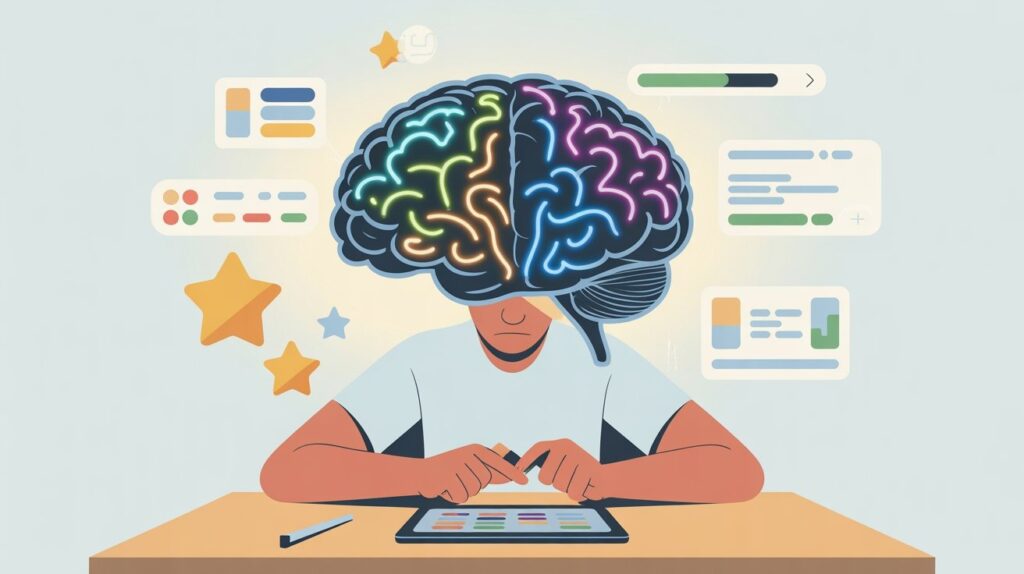
Not every gamification technique works for every child with ADHD. Some children are motivated by competition and leaderboards. Others find them overwhelming and prefer personal progress tracking instead. Some love narrative-based games with characters and storylines, while others respond better to clear, clean challenge structures without extra complexity.
This is why personalised tutoring for ADHD children in the UK must go beyond simply applying a generic gamified platform. The best tutors take time at the start of a new client relationship to understand which game elements motivate the individual child and which create anxiety or distraction. A child who is frustrated by competitive elements should never be put on a class leaderboard. A child who thrives on narrative will disengage from a purely mechanical points system.
Take Noah, a Year 7 student at a secondary school in Leeds, diagnosed with combined-type ADHD in September 2023. His tutor found that badge systems bored him but that a storyline approach, where each completed science topic unlocked the next chapter of an invented story about space exploration, kept him fully engaged for sessions of up to 50 minutes. By February 2024, Noah had completed 12 sessions without a single disengagement episode.
The most effective tutoring for ADHD students in the UK is built around knowing the child first. Gamification is a tool, and like any tool, it works best when it is chosen to fit the specific task and the specific person.
Practical Tips for Parents Supporting Gamified Online Tutoring at Home
Parents play an important role in making gamified online tutoring work effectively, especially for younger children. A few consistent habits at home can significantly improve how much a child benefits from each session.
• Create a distraction-free physical space: A consistent tutoring spot with minimal visual clutter helps ADHD brains stay oriented toward the screen.
• Celebrate badges and milestones verbally: When a child earns a new level or badge, acknowledge it with genuine enthusiasm. External recognition doubles the motivational effect for ADHD children.
• Keep sessions to the agreed length: Avoid extending a session because a child is engaged. ADHD children often have a hard stop after sustained effort, and overrunning can cause emotional crashes that damage next-session motivation.
• Ask the tutor for a summary of what was earned: Reviewing the badges, points, or progress map together after the session builds metacognitive awareness and reinforces the connection between effort and achievement.
• Communicate changes in the child’s state: ADHD children’s medication, sleep quality, and mood all affect session performance. Sharing this context with the tutor allows them to adjust the session’s pacing and challenge level accordingly.
What to Look for When Choosing an Online Tutor for an ADHD Child
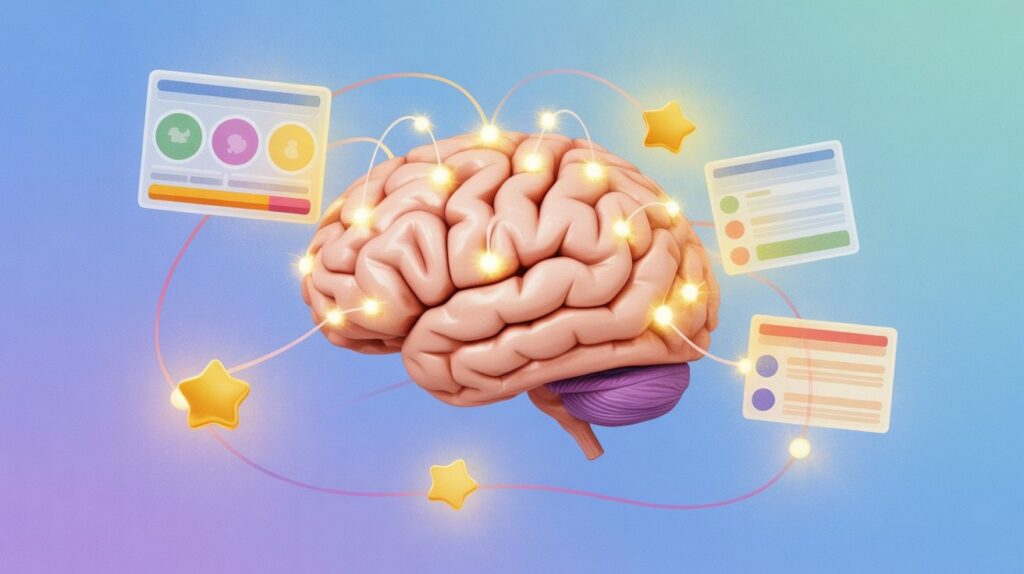
Not every online tutor is equipped to work effectively with ADHD students. Many are excellent at subject delivery but have little training in neurodevelopmental learning differences. When choosing a tutor specifically for an ADHD child, parents should look for several specific qualities.
• Experience working with neurodiverse learners, ideally with references or case examples
• Familiarity with UK educational frameworks including SATs, GCSE, and SEND support structures
• A clear approach to session structure with activity changes every 10 to 15 minutes
• Use of gamification tools either within their own platform or through third-party applications like Kahoot, Quizlet, or ClassDojo
• Willingness to adapt and communicate with parents after each session about what worked and what did not
• A calm, patient communication style that does not respond to distraction or impulsivity with frustration
According to the ADHD Foundation UK, children with ADHD who receive consistent, structured academic support from trained educators show measurably better outcomes in both academic performance and self-esteem compared to those who receive only medication management. Finding the right tutor is therefore not a luxury for these families. It is a genuine educational priority.
The platform YourTutor365 provides personalised tutoring for ADHD children UK with tutors who are trained in neurodiverse learning strategies and experienced in applying gamification techniques across primary school, SATs, GCSE, and other UK academic contexts.
Conclusion
ADHD does not mean a child cannot learn. It means a child learns differently, and the learning environment needs to meet that difference with intention. Gamification, when applied thoughtfully and personalised to the individual child, is one of the most powerful tools available to tutors working with ADHD students online.
From badge systems and timed sprint challenges to narrative-driven progress maps and instant reward loops, these techniques work because they align with the neuroscience of ADHD rather than fighting against it. Children like Oliver in Manchester, Ella in Birmingham, and Noah in Leeds are not unusual success stories. They are what happens consistently when the right strategies are applied with the right support.
If your child is struggling to engage in online tutoring for ADHD students in UK, the answer is rarely to try harder with a conventional approach. The answer is to change the approach entirely. Gamification, consistent structure, and a tutor who genuinely understands ADHD learning strategies for kids and interactive tutoring for neurodiverse kids can make the difference between a child who dreads sessions and one who asks when the next one is.
At YourTutor365, every child with ADHD is matched with a tutor who understands their specific learning profile, uses proven gamified learning for ADHD strategies, and adapts every session to keep engagement high and progress consistent. Book a free assessment today at yourtutor365.com and take the first step toward a tutoring experience that genuinely works for your child.
FAQs
1. What is gamification in online tutoring for ADHD students?
Gamification in tutoring means using game elements like points, badges, timed challenges, and progress maps to make learning more engaging, particularly for ADHD children who respond strongly to immediate rewards and clear visual goals.
2. Does gamified learning really help ADHD children focus better online?
Yes, research published in 2022 found that ADHD students showed a 34% improvement in on-task behaviour during gamified sessions, because game mechanics align with the way ADHD brains process motivation and reward.
3. How should gamification be adapted for ADHD children preparing for SATs or GCSEs?
For SATs and GCSE preparation, gamification works best through timed subject challenges, badge collections linked to topic mastery, and progress maps that break the syllabus into clearly unlockable stages, giving ADHD learners short-term goals within long-term preparation.
4. What should parents look for in online tutoring for ADHD students in the UK?
Parents should look for tutors with SEND experience, familiarity with the UK curriculum including GCSE and primary school SATs, a structured session format with regular activity changes, and clear use of gamification tools that are personalised to the child’s specific motivational style.
5. How long before gamification techniques show results for ADHD learners?
Most ADHD students begin showing improved engagement within 2 to 4 weeks of consistent gamified sessions, with measurable academic progress typically visible after 6 to 8 weeks when the approach is well matched to the individual child’s learning profile.
